
Altitude is a vital component of Mendoza viticulture, yet it is not the kingmaker, argues Matias Prezioso. Instead, we need to look beneath the vines.
In the Uco Valley, soil pits are dug with a pickaxe. The sound changes at 20 or 40 centimetres, when the tool strikes rounded cobbles and returns a dull, flat knock. Further down, it changes again, as a white crust of calcium carbonate appears, the layer Mendoza calls caliche.
To a grower, those sounds can say more about a vineyard than any technical sheet.
For the past two decades, the first word Mendoza taught the world was altitude. It worked, and it still works remarkably well. A figure in metres above sea level was enough to explain the diurnal range, the intensity of the light and the slow ripening that turned Malbec into Argentina's ambassador. The word travelled to London, New York and Shanghai. While the market was learning to recognise it, producers were beginning to ask what happens within those metres. The answer lies a few metres further down, in the position each parcel occupies within the alluvial fan, and in what the winemaker decides to do with it.
I have been travelling through Mendoza since 2006, and that shift, from the figure to the soil, sums up what I have watched change over those years.
An alluvial fan forms when a mountain river leaves the narrow gorge of the cordillera and spreads its load across the plain. The largest stones settle first; sand and silt appear further out. A vineyard sitting on the upper fan, on the plateaux formed by those terraces, grows on stone and drains quickly. Another, only a few kilometres away and at a similar altitude, may grow on finer material with greater water retention. Both can sit at 1,100 metres and produce markedly different wines.
Altitude describes a variable. The position of the parcel begins to describe a place.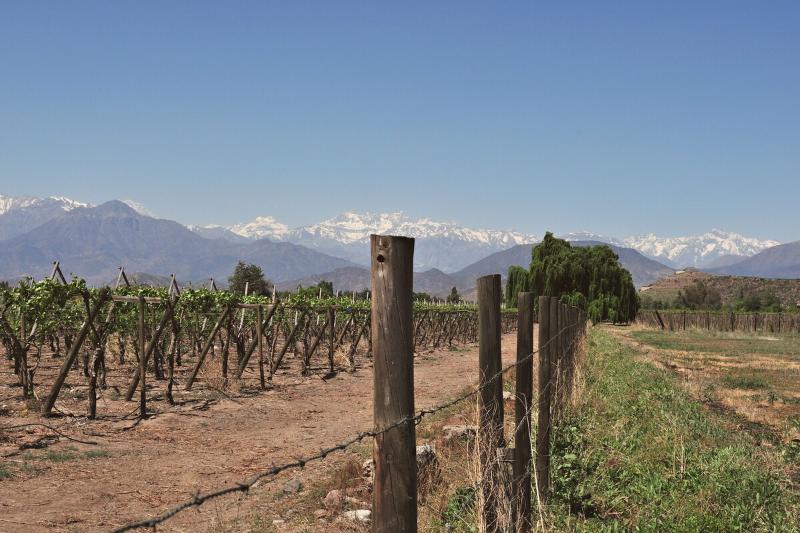
The Two Malbecs
That shift has produced two ways of understanding the same grape.
The first is the one that made Argentina famous. It has body, considerable alcohol, ripe fruit in the foreground and evident oak rounding the whole. It is a generous, immediate wine, recognisable even in a blind tasting. It built the category, and it still defines what many drinkers expect when they open an Argentine bottle for the first time.
The second was born in the soil pits. It seeks calcareous soils for tension, minerality and acidity. It treats its vessels gently, using older oak, concrete, large foudres and concrete eggs, and can dispense with wood altogether when that serves the wine. It offers less fruit at the start and more texture at the finish.
The two styles sit side by side on the same shelves, and sometimes inside the same winery. The difference between them is one of intention rather than quality.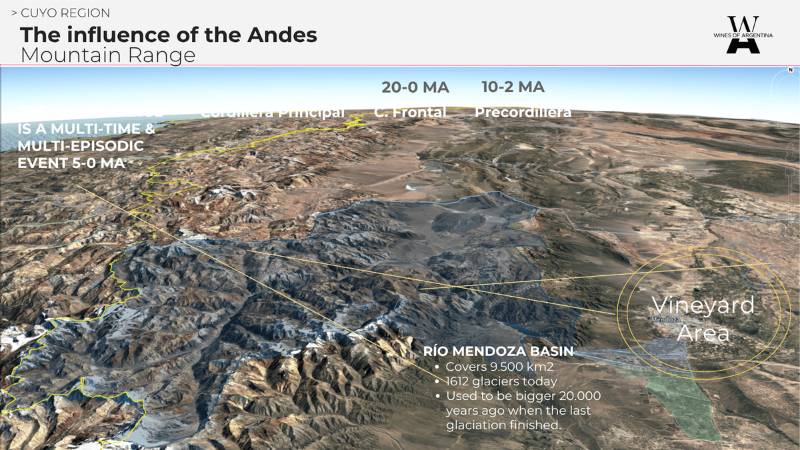
Credit: Wines of Argentina
Uco Valley
The second style was built here above all, which is why the valley now holds both the conversation and the greatest concentration of new planting from these decades.
Gualtallary occupies the upper part of the Las Tunas River alluvial fan, in Tupungato, at the foot of the Andes. Its political boundary coincides with that geological unit, a rare correspondence in the province. Viticulture developed strongly there from the 1990s onwards and accelerated over the past 15 years. Vineyards begin at around 1,100 metres and can reach 1,600, growing on stone, sand and calcareous deposits, with limited water availability.
Further south, in San Carlos, Paraje Altamira offers a different story. It sits on the Tunuyán River fan, between 1,000 and 1,200 metres. Growers there knew from the early twentieth century that certain sectors commanded higher prices, long before any formal category existed to describe them.
In December 2013, the Instituto Nacional de Vitivinicultura recognised it as a Geographical Indication, on the basis of soil studies carried out by the Faculty of Agricultural Sciences at the National University of Cuyo. It was a signal that the Argentine wine map could begin to be drawn from the ground rather than from an administrative boundary.
Its wines established another way of talking about Mendoza, with words such as texture, stone and calcium carbonate, which find particularly fine expression in Malbec, Cabernet Sauvignon and even Semillón.
The process continued. Los Chacayes gained its Geographical Indication in 2017, on the alluvial fan of the Arroyo Grande, which descends from the El Portillo range. San Pablo has earned recognition for whites and reds of marked tension, with its western boundary at the 1,700-metre contour and an appealing degree of cloud cover thanks to its proximity to the mountains. Pampa El Cepillo and La Consulta hold old vineyards and a cool climate that comes more from latitude than altitude.
Behind each of those names lie soil pits, soil analyses, vigour mapping and, above all, a great deal of soul-searching among producers. To name a place is also to decide which difference deserves recognition.
Luján de Cuyo
Las Compuertas, Vistalba, Perdriel and Agrelo hold Malbec planted more than 50 years ago, tied to historic irrigation systems and to pergolas that have survived several generations of market change. The Luján de Cuyo DOC emerged from here, created in 1989 and the first of its kind in the Americas. Its Malbecs represent a Mendoza of lower altitude but longer historical continuity, with a close relationship between vineyard, city and farming.
The area remains in motion. In 2025, the Alto Agrelo Geographical Indication was approved, prompting neighbouring producers in Perdriel, Agrelo and Ugarteche to reconsider the meaning of their own terroirs. Further east, Maipú adds Lunlunta, Russell and Barrancas, with parcels whose significance outstrips their commercial standing.
Eastern Mendoza
San Martín accounts for 18.1% of the province's vineyard area, ahead of Luján de Cuyo at 10.8%. Together with Rivadavia, Junín, Santa Rosa and La Paz, it forms a vast viticultural landscape where Criolla varieties survive alongside Bonarda in old vineyards that spent decades outside the conversation.
A generation of producers has now returned to those parcels, bottling them separately and achieving surprising results, with higher yields per hectare and more accessible prices.
What to Ask of an Argentine Wine
Faced with a wine from Mendoza, three questions take you further than any list of wineries and labels.
The first asks what this place is and how it was delimited. A Geographical Indication drawn along differences in soil tells a different story from a name inherited from an administrative division..jpg)
The second looks beyond altitude. Two parcels three kilometres apart can occupy opposite positions within a fan, and that distance can count for more than any figure in metres.
The third points to the winery. Which vessel did the winemaker choose? How much oak was used, and with what intention? That decision helps explain which of the two Malbec styles ended up in the bottle.
The Uco Valley organised this conversation because there the soil became a commercial argument before it did anywhere else in the province. Mendoza spent 30 years teaching the world the name of a grape variety, and it is now beginning to teach the names of its places.
That learning advances slowly, because every new name demands soil pits, agreement among producers, and vintages to prove it.
Mendoza has learned to read its soils. Now it is choosing what to tell us about them.

Get expert insights, weekly highlights, and exclusive stories from the world's most trusted wine competition.