
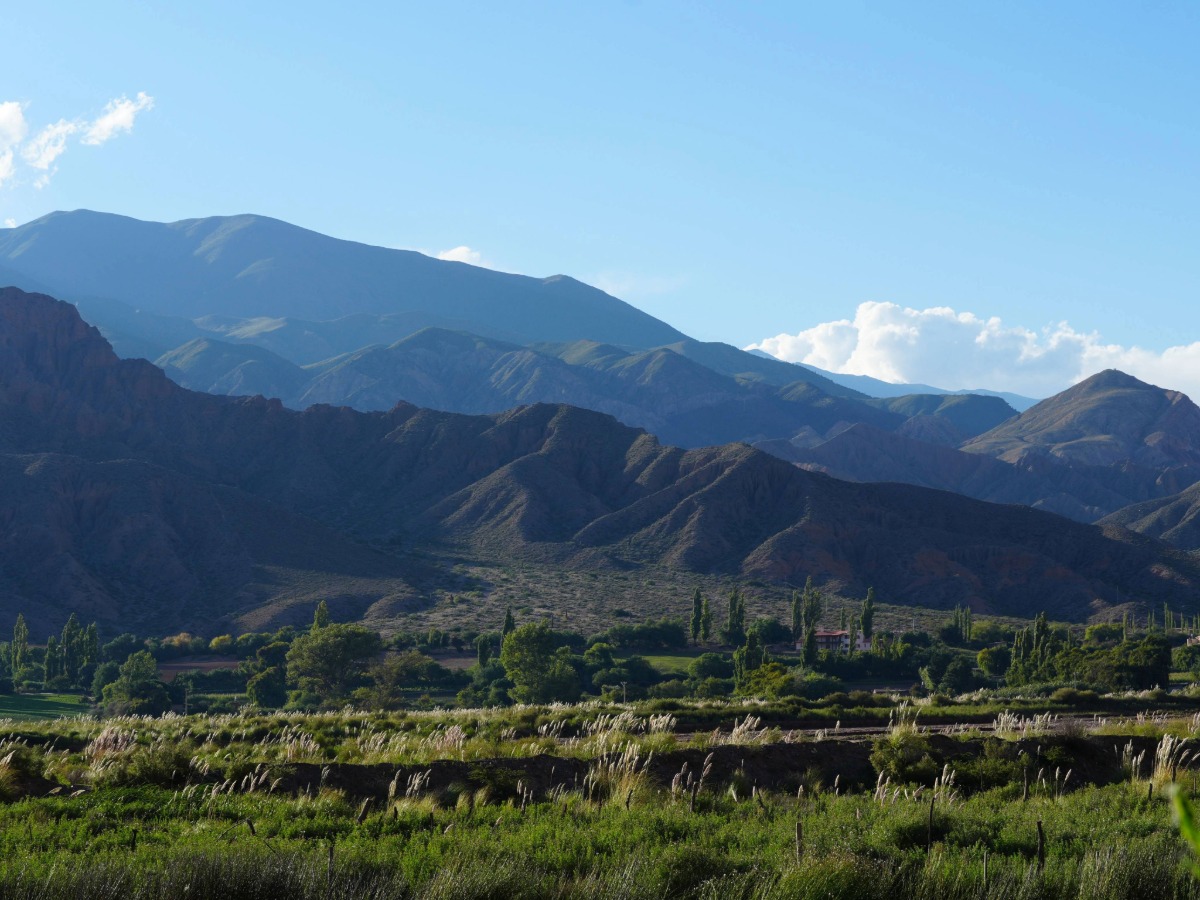
From the Calchaquí Valleys to the extreme vineyards of Jujuy, northwest Argentina is finding new ways to express its terroirs.
At Moya, in the Quebrada de Humahuaca, vines grow at more than 3,300 metres above sea level, close to the Tropic of Capricorn. Jujuy is home to some of the world's highest vineyards, where harvesting can extend into May as grapes ripen slowly and each growing season brings its own challenges.
Argentina's northernmost wine region is shaped by altitude, the difference between daytime and nighttime temperatures, intense solar radiation and limited water availability. In the Andean valleys, temperatures fall by around 0.6°C for every 100 metres of elevation. Vineyards combine intense sunshine with cold nights, while viticulture depends on irrigation. Over the past decade, producers have built on these conditions by mapping their terroirs more precisely, reviving grape varieties and developing distinctive styles.
For those who know Argentina primarily through Mendoza Malbec, the northwest offers a different perspective on the country's wines. Here, the landscape can change dramatically within a few kilometres, and altitude is where the story begins.
Salta and the Calchaquí Valleys
Salta attracts most of the international attention devoted to northwest Argentina's wines. Its vineyards lie in the Calchaquí Valleys, a corridor stretching for some 270 kilometres across Salta, Tucumán and Catamarca. Cafayate, which accounts for 75.6% of the province's vineyard area, is the region's best-known reference point. Further north, around Molinos and Cachi, vines reach even greater elevations.
Salta has around 3,700 hectares under vine, a modest area compared with Argentina's major wine-producing provinces. Yet the province punches above its weight in exports and quality wine production. It is also one of the few Argentine provinces to have expanded its vineyard area over the past decade, adding 456 hectares.
Malbec is the leading variety. In the 2026 harvest, it accounted for 48% of the province's grapes, followed by Torrontés Riojano at 28%. Intense sunlight, cold nights and a dry climate favour concentrated colour and tannins. Cabernet Sauvignon has also developed a distinctive expression, combining ripe fruit with spicy notes. Its evolution reflects both the region's terroir and the influence of Bordeaux and Californian winemakers who began working there in the 1990s.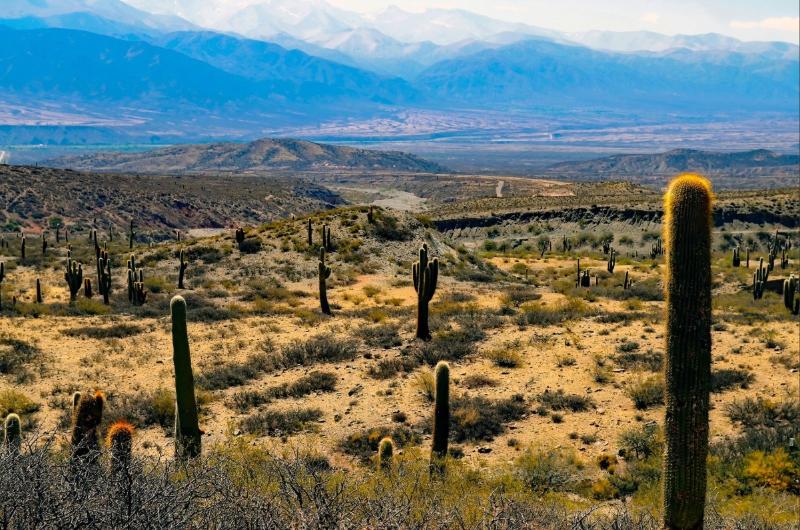
Alongside these powerful expressions, producers are increasingly focused on preserving freshness and revealing the differences between individual vineyards.
The region's signature white grape is Torrontés Riojano. Cafayate is the spiritual home of Torrontés in Argentina, where local music accompanies tables laden with Salta-style empanadas and glasses of youthful, aromatic wine.
A genetic study published in 2003, led by researcher Cecilia Agüero, established that Torrontés Riojano is the result of a natural cross between Muscat of Alexandria and Criolla Chica. In the Calchaquí Valleys, its floral and citrus aromas are balanced by lively acidity in its youth. A characteristic bitter edge divides opinion, but it also has its admirers.
Catamarca and its family vineyards
Catamarca offers a different model of viticulture, closely connected to family farming. Its just over 2,000 hectares of vineyards are divided among numerous small holdings, averaging around three hectares each - the smallest average holding size among Argentina's leading wine provinces. This family-based structure has roots stretching back to the colonial period.
The towns of Tinogasta and Fiambalá, together with the Catamarca section of the Calchaquí Valleys around Santa María, each have their own growing conditions and traditions. International varieties share the vineyards with Criolla grapes that form part of the region's agricultural heritage.
Cereza, a pink-skinned Criolla variety traditionally used to make table wine and grape must, accounts for almost half of the grapes harvested in the province.
Catamarca's challenge is to turn this diversity into a recognisable regional identity. The small scale of its vineyards limits the availability of individual wines, but it also creates opportunities to explore lesser-known varieties and express the character of individual plots.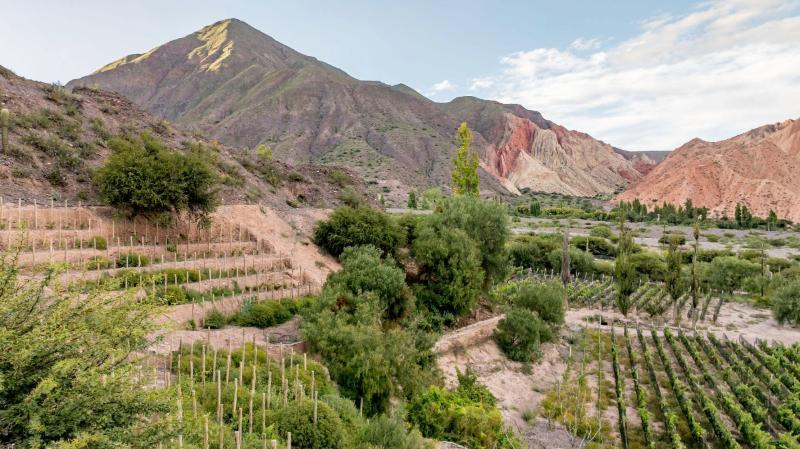
Photo credit: Huichaira Vineyard, Tilcara, Jujuy, Argentina. Aerial photography
Jujuy: from the Quebrada de Humahuaca to the Valles Templados
Jujuy is perhaps the most recent discovery in Argentina's northwest wine region. Its viticulture is developing along two complementary paths. The Quebrada de Humahuaca has become synonymous with extreme-altitude vineyards, while the Valles Templados, in the south of the province, are beginning to attract recognition for their distinct growing conditions.
With just 72 hectares spread across almost 30 vineyards, Jujuy has the smallest vineyard area of the three provinces. Nevertheless, its wines are generating increasing interest among specialist buyers and the wine trade.
The Quebrada de Humahuaca was recognised as a Geographical Indication (GI) in 2015, with official publication in January 2016. Its pronounced diurnal temperature range - the difference between daytime and night-time temperatures - helps produce full-bodied wines with intense flavours and generous alcohol levels, which can exceed 15%.
In 2025, a second GI, Valles Templados, was added. Situated near San Salvador de Jujuy, at elevations of roughly 1,000 to 1,600 metres, this area harvests earlier than the Quebrada and produces fresher, lighter wines with lower alcohol levels, particularly whites and rosés. The reds can display smoky notes, which local producers associate with the region's tobacco-drying sheds.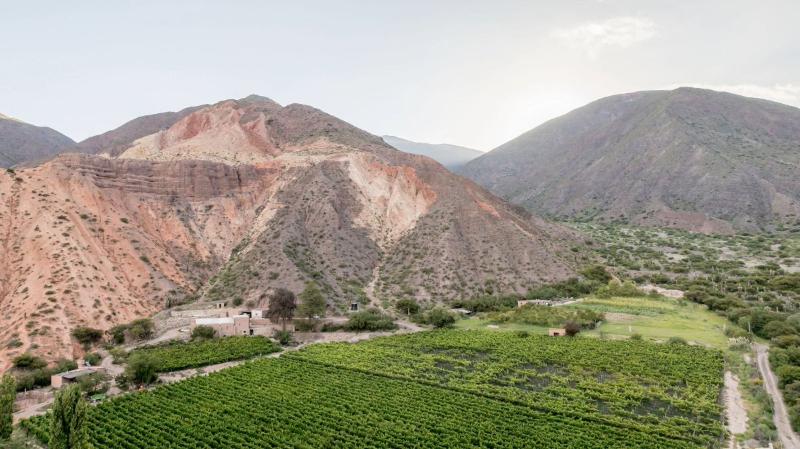
Photo credit: Huichaira Vineyard, Tilcara, Jujuy, Argentina. Aerial photography
Criolla Chica: a grape that connects a continent
Criolla Chica is one of the two parent varieties of Torrontés Riojano, the other being Muscat of Alexandria. The grapes are distinct varieties linked through a natural cross. Criolla Chica is itself genetically identical to Listán Prieto in the Canary Islands, País in Chile and Mission in California. It was among the first grape varieties to reach the Americas during the colonial period.
For centuries, it supplied wine for local consumption. Today, Argentina's National Wine Institute (INV) recognises it as a red grape suitable for quality wine production. Producers in the Calchaquí Valleys and the Quebrada de Humahuaca are now making high-altitude reds from Criolla Chica that combine individuality with finesse.
Its shared history connects northwest Argentina with wine-producing regions across the Americas - a connection that resonates with the wines being judged this week at IWC Americas in Mendoza.
In the northwest, Criolla grapes also raise questions about the future. What happens when a traditional variety is grown at high altitude? What styles can emerge from small vineyards exposed to extreme conditions and shaped by different viticultural practices? And how can these wines establish a distinctive identity in international markets?
The answer lies in translating a strong sense of origin into consistent quality, a clear identity and sustained commercial success. That work is already under way, driven largely by the consolidation of Salta and the emergence of Jujuy's diverse terroirs.
Malbec helped establish Argentina's reputation as a wine-producing country. In the northwest, a grape brought to the Americas by European colonists is finding a new expression as a high-altitude red, bringing together the history of the vine across the continent and the contemporary work of the region's producers.

Get expert insights, weekly highlights, and exclusive stories from the world's most trusted wine competition.